
Introduction
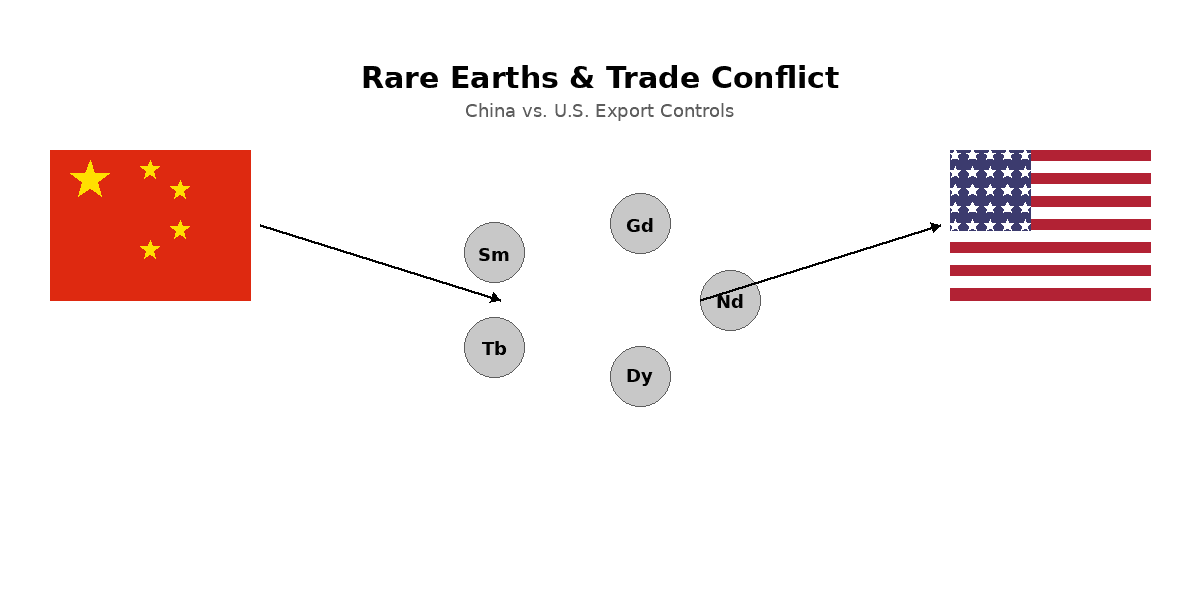
In October 2025, China announced sweeping new export controls over rare earth elements, technologies, and even foreign-made products that incorporate Chinese inputs. The move extends a years-long strategy of tightening control over critical raw materials. In reaction, former U.S. President Donald Trump threatened a “massive increase” in tariffs on Chinese goods and canceled a planned bilateral meeting with President Xi Jinping. The escalation signals a new phase in how trade, national security, and industrial strategy intertwine. In this post, we’ll walk you through how China’s export rules evolved, what the new controls entail, and how Trump’s response fits into the bigger picture.
A Short History: How China Built This Leverage
Even before October 2025, China gradually expanded control over certain raw materials and dual‑use technologies. In 2020, the country passed a comprehensive Export Control Law, establishing the legal basis for regulating strategic exports. By mid‑2023, it had imposed licensing requirements on gallium and germanium, and later in 2023 and 2024 controls expanded to graphite, antimony, tungsten, tellurium, and medium‑to‑heavy rare earths. Until now, most controls focused on merchandise exports such as raw materials and parts. China’s October 2025 move goes further: it targets know‑how, technologies, and foreign products using Chinese‑origin inputs. The export regime has become more systemic. It’s no longer just about limiting the flow of minerals — it’s about embedding those controls deeper into global supply chains and production systems.
What’s New in October 2025
| Feature | New rule / extension | Implications |
|---|---|---|
| Scope of products & tech | China now extends control to foreign‑made items that incorporate Chinese rare earths or technology. | Even if final goods are made outside China, they may need Chinese export licences if they contain enough Chinese inputs. |
| Licensing & scrutiny | Exporters must obtain licences from China’s Ministry of Commerce. Applications related to defence, semiconductors, or advanced tech face stricter reviews. | Firms in high‑tech or defence sectors face uncertainty in approvals. |
| Ban for defence users | Chinese authorities now deny licences for foreign defence users outright. | Military and dual‑use industries outside China may face material shortages or forced substitution. |
| Export control over related tech | Controls now include technology, know‑how, and machinery used in mining, refining, magnet production, and recycling. | The control point shifts upstream in the value chain — not just the raw minerals, but the tools to refine them. |
These rules begin enforcement in December 2025, and some require compliance even if the product is manufactured abroad. One striking aspect: even trace amounts (as low as 0.1% by value) of Chinese‑origin rare earths or related tech can trigger licensing. In short, China’s control network no longer stops at borders — it reaches into global value chains.
Trump’s Response: Tough Talk & Tariff Threats
Trump didn’t hold back. On 10 October 2025 he announced that he would not meet Xi in South Korea as previously planned. He threatened a “massive increase” in tariffs on Chinese imports, citing China’s export controls as destabilising to global markets. He claimed that China’s actions risk holding the world “captive” on rare earths and strategic materials. Markets responded: rare earth stocks surged, while global auto and industrial stocks dipped on fears of a renewed trade war. In short, Trump is attempting to turn China’s move into a political rallying point for aggressive trade retaliation.
Why This Matters: Supply Chains, Strategy & Risk
- Strategic choke points
Rare earths and materials like gallium, germanium, and tellurium are essential in semiconductors, defence systems, green energy, magnets, and more. Because China controls so much of the processing side (not just mining), this gives it unique leverage. - Raising the cost of dependence
Any nation or company relying heavily on Chinese inputs may now face licensing burdens, delays, or outright supply cuts. That risk can push them to accelerate diversification. - Escalation risk
Trump’s tariff threats could provoke countermeasures, creating a spiral of trade retaliation. China’s rules are partly reactive to U.S. export controls, so a tit‑for‑tat dynamic could ensue. - Industrial and defence impact
Cutting access to critical inputs can hamper advanced manufacturing, defence R&D, and strategic sectors, particularly in countries with weak upstream capacity. - Signal effect
This is no longer just about China vs. the U.S. It’s a signal to all nations: control your own critical supply chains or risk vulnerability.
What to Watch & Possible Scenarios
- Licensing bottlenecks: Will China approve or deny licences selectively to influence policy outcomes?
- Retaliatory tariffs: Will the U.S. or partners impose new tariffs or restrictions in response to China’s controls?
- Supply chain realignment: Investment into rare earth mining, refining, and recycling in the U.S., Europe, Australia, and elsewhere.
- Third‑party pressure: Allies may face pressure to pick sides (e.g., support U.S. tariffs or comply with Chinese licensing).
- Diplomatic escalation or détente: Will Trump and Xi negotiate, or double down?
Conclusion
China’s 2025 export control expansion marks a turning point. It’s no longer enough to control where minerals go — the country now seeks to control what is made with them and who can use them. Trump’s tariff threats suggest the U.S. may respond in kind, raising the spectre of intensifying strategic rivalry. For business leaders, governments, and supply chain strategists, the questions are urgent: how much exposure do you have to Chinese critical inputs? How fast can you build alternative supply chains? And will the global rules of trade survive this era of geo‑economic competition?