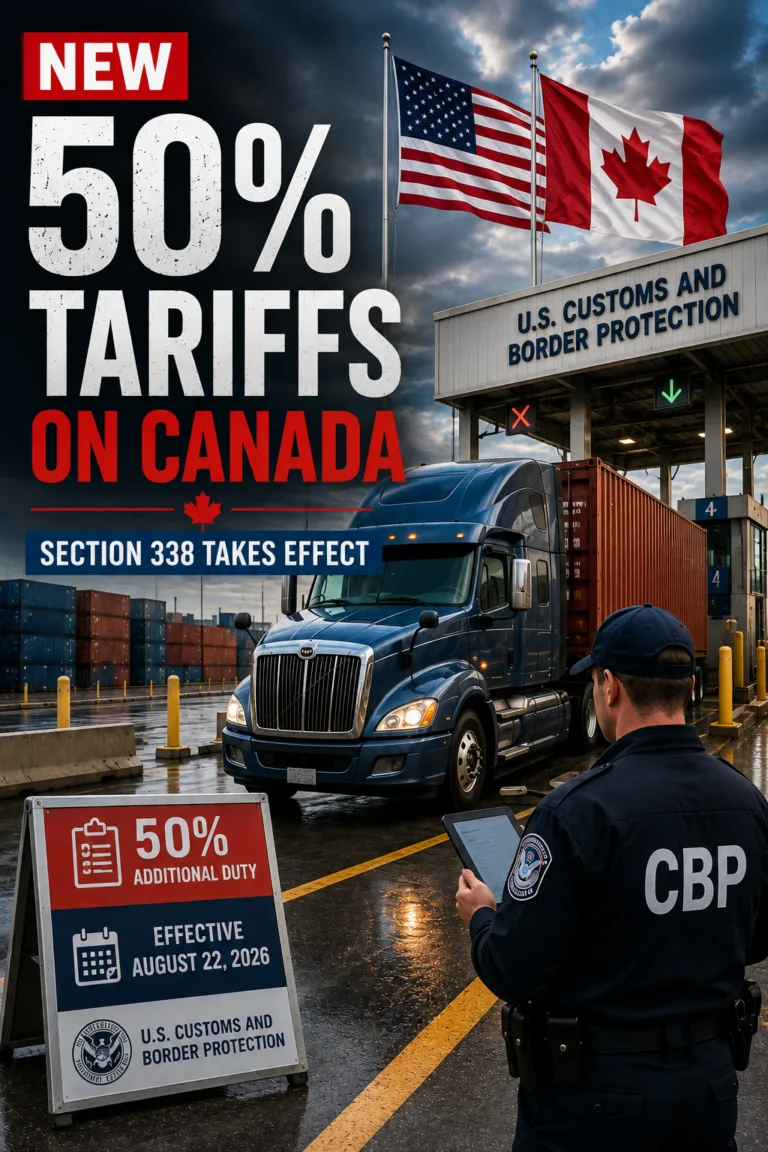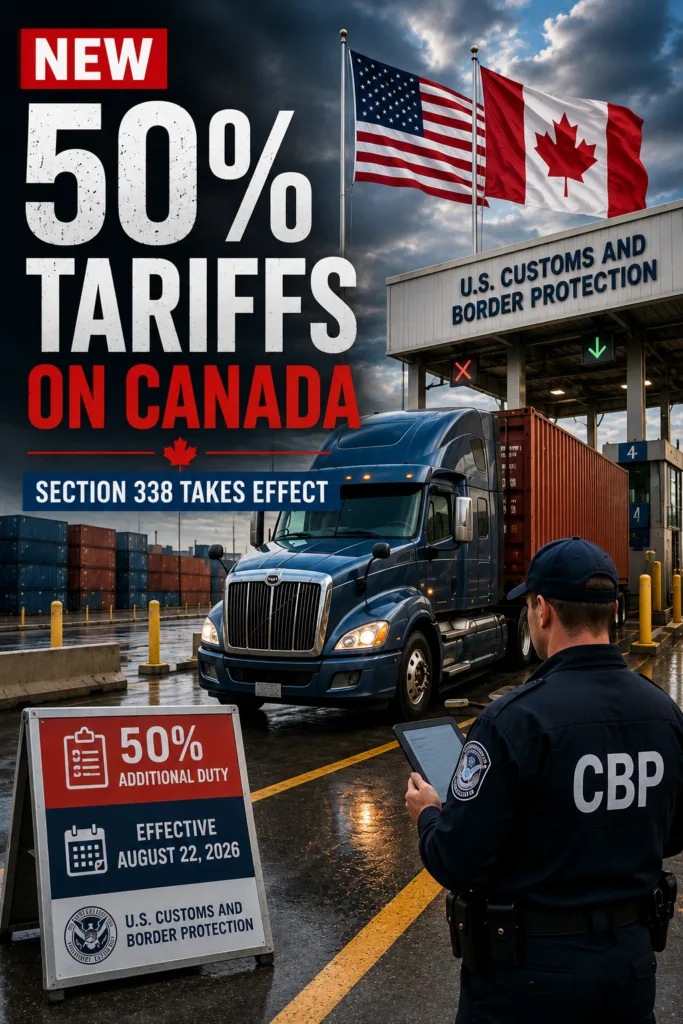

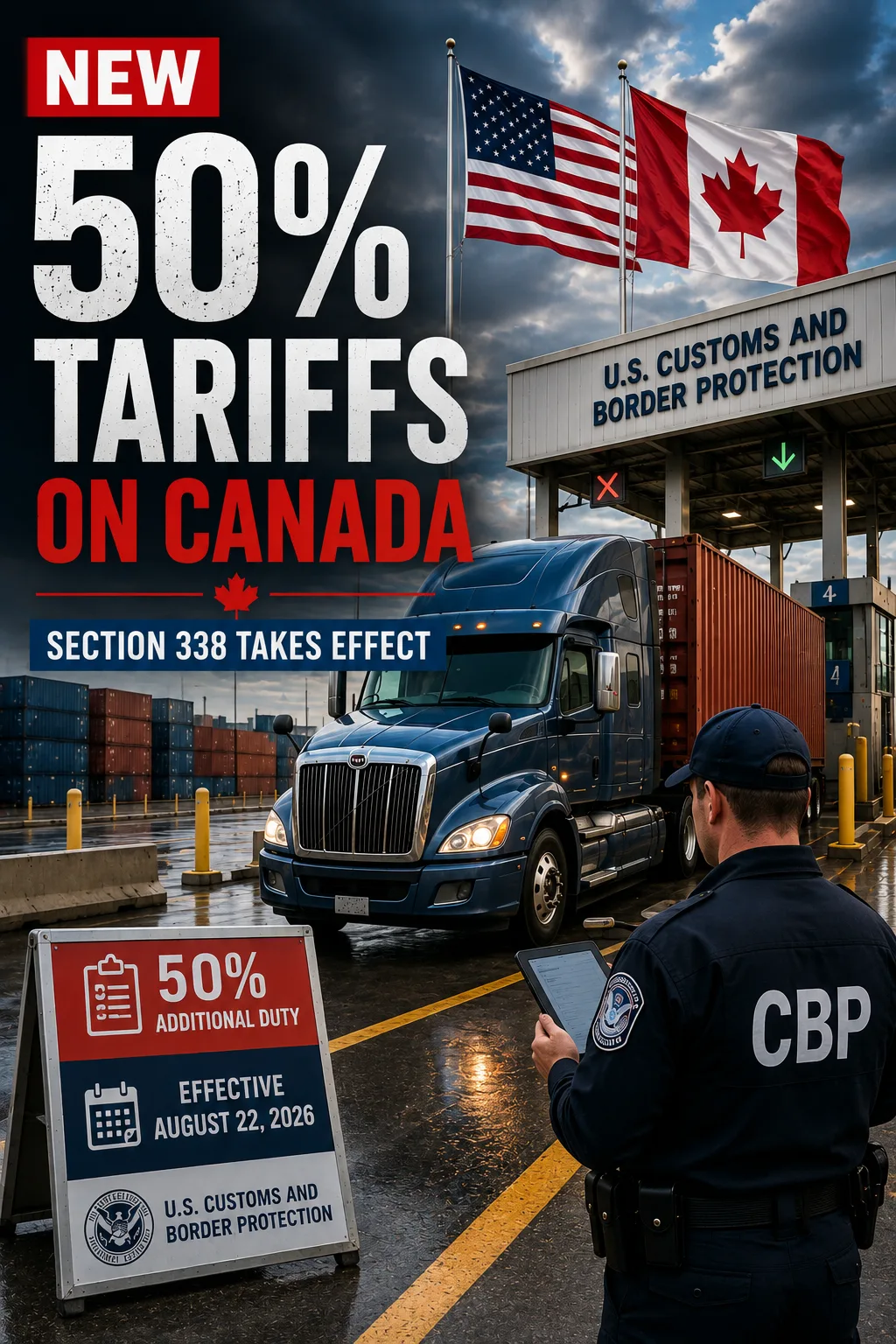
U.S. Customs and Border Protection (CBP) has issued detailed filing instructions for the new Section 338 tariffs on certain Canadian-origin goods, with the additional duties taking effect at 12:01 a.m. Eastern Time on August 22, 2026.
The tariffs were originally scheduled to begin on August 19, but the White House temporarily suspended implementation for three days while the United States and Canada continued discussions. That suspension has now expired. CBP’s new guidance confirms how importers, customs brokers, and other filers must report the additional duties in ACE.
The Section 338 tariffs impose an additional 50% ad valorem duty on specified Canadian products covered by three separate Presidential Proclamations involving alcoholic beverages, dairy products, and motor vehicles. The actual product coverage, however, extends beyond those three categories and includes a broader range of goods identified by specific HTSUS provisions.
When Do the Section 338 Tariffs Apply?
For customs entry purposes, the key date is now August 22, 2026.
CBP states that the additional duties apply to covered goods of Canada that are:
- Entered for consumption, or
- Withdrawn from a warehouse for consumption
on or after 12:01 a.m. Eastern Time on August 22, 2026.
The three-day delay was established by Presidential Proclamation 11056, which temporarily suspended the additional duties originally scheduled for August 19.
This means importers should pay particular attention to the entry date and warehouse withdrawal date, rather than simply the date the merchandise arrived in the United States.
Which Chapter 99 Numbers Apply?
CBP’s guidance identifies five relevant Chapter 99 headings:
| Chapter 99 HTSUS | Additional Duty | General Scope |
|---|---|---|
| 9903.03.12 | 50% | Specified Canadian products under U.S. Note 51(b)(1) |
| 9903.03.13 | 50% | Specified Canadian products under U.S. Note 51(b)(2) |
| 9903.03.14 | 50% | Specified Canadian products under U.S. Note 51(b)(3) |
| 9903.03.15 | 0% | Certain Section 232-covered products and other specified goods |
| 9903.03.16 | 0% | Certain qualifying civil aircraft and related products |
The first three headings are the primary 50% Section 338 tariff provisions.
Importers should not determine applicability based only on a product’s commercial description. The applicable HTSUS classification and the corresponding U.S. Note 51 provisions control whether the additional duty applies. The Federal Register notices provide the detailed tariff classifications associated with the three actions.
The 50% Duty Is an Additional Duty
One important point for importers is that the 50% rate is an additional ad valorem duty.
It does not necessarily mean the importer will pay exactly 50% total duty.
For example, if a covered product has a normal HTSUS duty rate of 6%, the Section 338 provision adds another 50 percentage points, subject to the specific tariff provisions applicable to that merchandise.
CBP also states that covered products remain subject to other applicable:
- Antidumping duties
- Countervailing duties
- Other tariffs
- Taxes
- Fees
- Exactions and charges
Therefore, importers should review the entire Chapter 99 duty stack before calculating the final landed cost.
USMCA Qualification Does Not Automatically Protect Covered Goods
Importers should also be careful about assuming that a Canadian product qualifying for USMCA/CUSMA preferential treatment automatically avoids the Section 338 duty.
The Section 338 measures apply to specified Canadian goods based on the applicable tariff provisions, and trade-industry analysis indicates that covered products do not receive a blanket USMCA exemption from the additional 50% duty.
This is particularly important for companies that have historically relied on USMCA to enter Canadian-origin products duty-free.
USMCA qualification and Section 338 applicability should be evaluated separately.
Certain Products Are Excluded or Subject to a 0% Section 338 Rate
Not every Canadian product is subject to the additional 50% duty.
The proclamations and CBP guidance provide important exclusions and special treatment.
Among the products receiving 0% additional duty under the identified Chapter 99 provisions are certain:
- Steel and aluminum articles
- Copper and derivative articles
- Passenger vehicles and light trucks
- Certain vehicle parts
- Medium- and heavy-duty vehicles and parts
- Wood products
- Semiconductor articles
- Patented pharmaceutical articles
- Civil aircraft and qualifying aircraft components
These provisions are reflected in 9903.03.15 and 9903.03.16.
Importers should still verify the exact HTSUS classification and applicable U.S. Note before assuming an exclusion applies.
Foreign Trade Zone Treatment
The new rules also have implications for Foreign Trade Zone operations.
CBP states that merchandise subject to the Section 338 duties and admitted into an FTZ generally must be admitted under privileged foreign status, unless it qualifies for domestic status under the applicable FTZ rules.
Upon withdrawal for consumption, the merchandise will be subject to the applicable ad valorem duty rate associated with its HTSUS classification.
Companies using FTZs should therefore review their admission and withdrawal procedures before assuming that FTZ treatment will eliminate or defer the Section 338 duty exposure.
What Importers and Brokers Should Do Now
With the tariffs now effective, companies importing from Canada should immediately review upcoming and pending entries.
Importers should:
- Review Canadian-origin products against the applicable Section 338 HTSUS lists.
- Confirm the correct 8-digit HTSUS classification.
- Determine whether the merchandise falls under 9903.03.12, 9903.03.13, or 9903.03.14.
- Review whether a 0% provision or other exclusion applies.
- Do not assume USMCA qualification eliminates the Section 338 duty.
- Recalculate landed costs for affected products.
- Review FTZ inventory and withdrawal procedures.
- Confirm whether other trade remedies apply.
Customs brokers should:
- Update ACE filing procedures.
- Verify Chapter 99 reporting sequences.
- Review client tariff databases and entry instructions.
- Confirm applicable Chapter 98 and Chapter 99 provisions.
- Watch for ACE rejects or filing issues related to the new provisions.
CBP advises filers experiencing entry-summary errors to contact their CBP client representative or the ACE Help Desk. Questions specifically concerning Section 338 entry filing can be directed to CBP’s Trade Remedy Branch.
The Bigger Picture for U.S.-Canada Trade
The economic impact will depend heavily on which products remain subject to the additional duty and how long the measures remain in place.
RBC Economics estimates that the newly tariffed products represent roughly 5% of Canadian exports to the United States, while more than 80% of Canadian exports are expected to remain duty-free under the broader CUSMA framework. RBC also notes that plastic products, electrical machinery, furniture, and wood products are among the sectors that could experience significant impacts.
For importers, however, the impact can be much larger at the individual shipment level. A 50% additional duty on a product with significant U.S. import volume can materially change the cost of sourcing from Canada.
The immediate priority should therefore be product-level analysis, rather than relying on broad statements about whether Canadian imports are subject to tariffs.
What Comes Next?
The implementation of the Section 338 tariffs adds another layer to an already complicated U.S.-Canada tariff environment.
The Administration could still modify the tariff provisions, product coverage, or implementation requirements through future presidential action or CBP guidance. Importers should therefore continue monitoring CBP messages and Federal Register updates.
For now, however, the message from CBP is clear: covered Canadian goods entered for consumption or withdrawn from warehouse for consumption on or after August 22, 2026, must be reviewed for the new Section 338 Chapter 99 requirements.
Official Sources & Further Reading
For readers who want to verify the legal and filing requirements, I recommend linking directly to the primary sources: