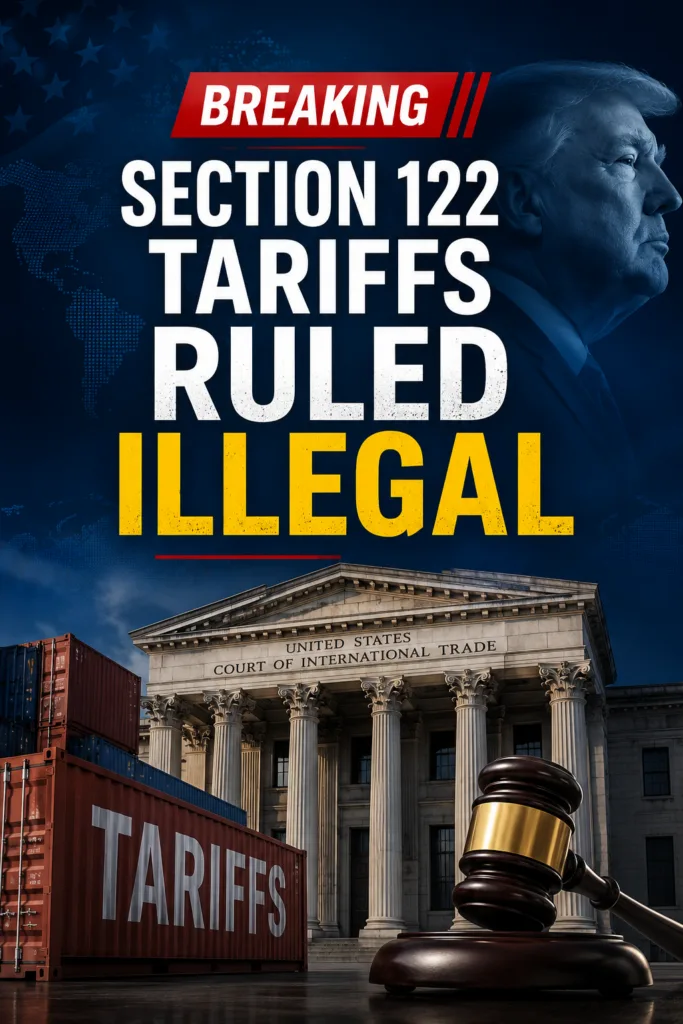


The Section 122 tariffs ruling 2026 is quickly becoming one of the biggest trade law developments importers have faced this year.
On May 7, the U.S. Court of International Trade (CIT) ruled that the Trump administration’s 10% global tariffs imposed under Section 122 of the Trade Act of 1974 were not legally justified under the statute. The court found that the administration failed to meet the legal requirement of showing a “large and serious balance-of-payments deficit” before imposing the tariffs.
For many importers, the ruling immediately raised the same question everyone asked during the IEEPA litigation earlier this year:
“Are these duties now gone for everybody?”
At the moment, the answer appears to be NO.
The Ruling Does Not Automatically Remove Duties for All Importers
One important detail getting lost in some headlines is that the decision currently applies mainly to the plaintiffs involved in the lawsuit.
CBP has not issued nationwide instructions stopping the collection of Section 122 duties for all importers. That means most entries are still being filed with the tariffs in place unless further court action or CBP guidance changes the situation.
Trade professionals are already comparing this to the earlier IEEPA tariff cases. In those cases, the first court victories were also limited in scope before broader legal decisions followed later.
Right now, many customs brokers are advising importers not to change filing procedures yet unless they are directly involved in the litigation or receive specific legal guidance from counsel.
Why the Court Rejected the Tariffs
Section 122 gives the president limited authority to impose temporary tariffs of up to 15% for 150 days when there is a serious balance-of-payments issue affecting the United States economy.
The court essentially concluded that a general trade deficit alone was not enough to justify the emergency use of Section 122 authority in this situation.
This ruling is significant because the Section 122 tariffs were introduced shortly after the earlier IEEPA tariffs were struck down by the Supreme Court in February 2026.
That sequence is now creating a broader legal debate over how far emergency tariff authorities can go when administrations attempt to bypass traditional trade remedy procedures.
What Importers Are Asking Right Now
Since the ruling came out, most of the questions across the trade industry have been operational:
- Should importers continue paying the tariffs?
- Should protests be filed now?
- Will refunds eventually become available?
- Is CBP going to suspend collection?
- Does this apply only to certain companies?
At the moment, there are still very few nationwide operational changes.
CBP systems remain active for Section 122 reporting, and there has not yet been broad guidance instructing brokers to stop filing the duties for all importers.
That could change later depending on appeals and future court orders.
What Happens Next?
The Trump administration is expected to appeal the ruling to the U.S. Court of Appeals for the Federal Circuit (CAFC), which means the legal process is far from over.
For now, most brokers are treating this similarly to the earlier IEEPA litigation timeline:
- initial court ruling
- appeals process
- possible stays or injunction changes
- eventual CBP implementation guidance later
If higher courts ultimately uphold the ruling on a nationwide basis, importers could eventually see:
- refund procedures
- reliquidation instructions
- ACE refund processing
- protest strategy discussions
- possible nationwide duty relief
However, none of that has officially been announced yet.
Importers with significant Section 122 exposure are still being advised to:
- keep detailed entry records
- monitor liquidation timelines
- watch protest deadlines carefully
- follow future CBP CSMS messages closely
Why This Matters Beyond Section 122
The bigger issue here is not just one tariff program.
This case adds more pressure around the government’s use of emergency trade authorities overall.
After the IEEPA decisions earlier this year, many trade attorneys already expected future tariff actions to move more toward:
- Section 301 investigations
- Section 232 national security tariffs
- industry-specific trade remedies
- traditional AD/CVD actions
Now, with Section 122 also facing serious legal problems, administrations may have fewer options for quickly imposing broad emergency tariffs without lengthy investigations or stronger statutory support.
For importers, this creates ongoing uncertainty around:
- landed cost forecasting
- sourcing decisions
- long-term contracts
- tariff planning
- duty recovery opportunities
The Industry Is Still Waiting for CBP Guidance
At this stage, the trade industry is mostly waiting for two things:
- appellate court activity
- future CBP instructions
Until broader guidance is issued, most customs brokers are continuing to file entries normally while closely monitoring the legal developments.
The situation remains highly fluid, and many importers are taking a cautious “wait and monitor” approach instead of making immediate operational changes.