
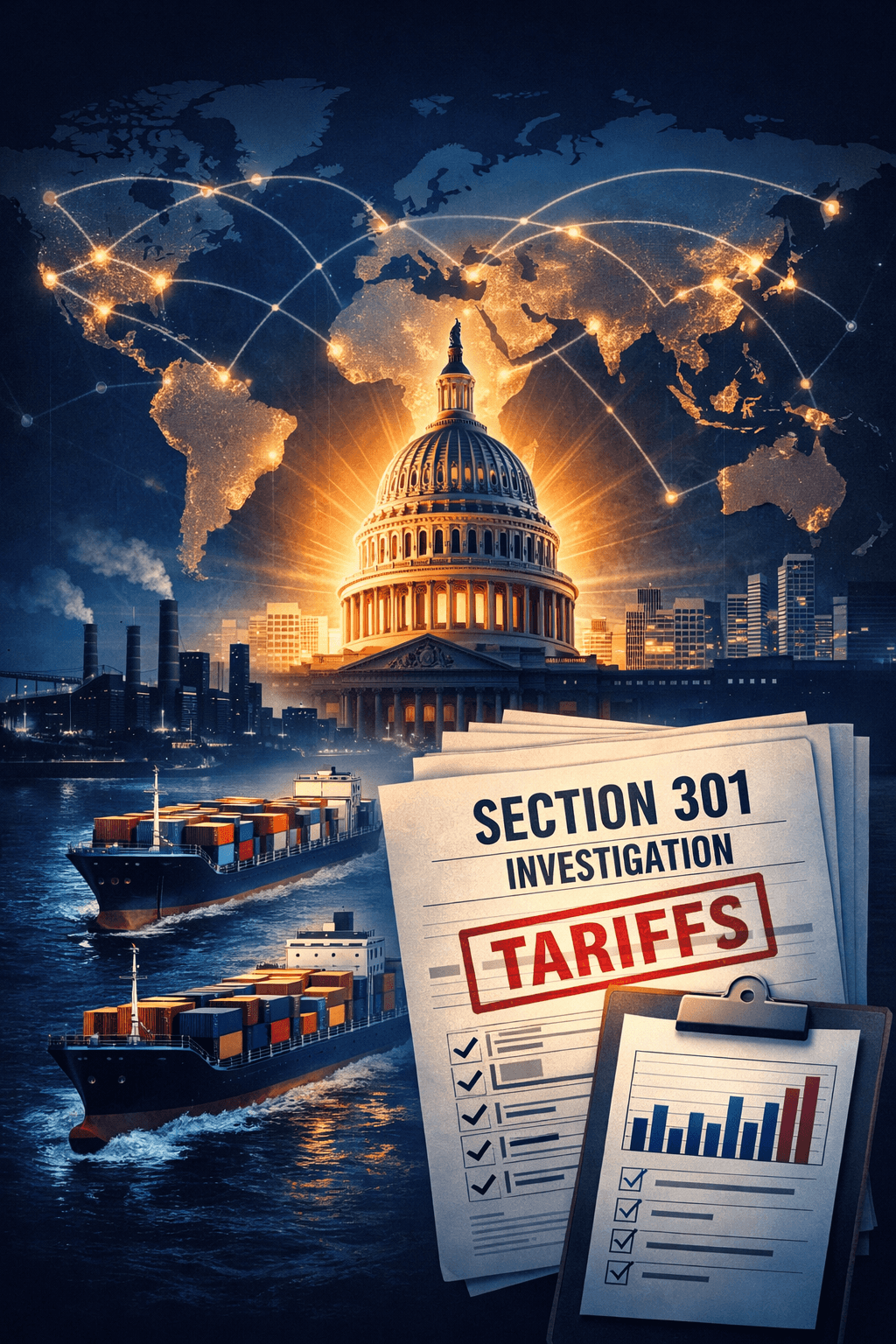
he Section 301 investigations 2026 officially began on March 11, 2026, when the Office of the United States Trade Representative (USTR) announced a new investigation into the trade practices of several major global economies.
These Section 301 investigations will examine whether certain countries maintain structural excess manufacturing capacity and production that may unfairly impact U.S. commerce and domestic manufacturing. USTR 301 FRN Industrial Excess
Under Section 301 of the Trade Act of 1974, the United States government can investigate foreign trade practices and, if they are determined to be unreasonable or discriminatory, impose trade remedies such as tariffs or import restrictions.
At this stage of the Section 301 investigations 2026, no new tariffs have been announced yet.
Countries Included in the Section 301 Investigations 2026
The Section 301 investigations 2026 currently focus on 16 major trading economies that appear to exhibit significant manufacturing overcapacity or persistent trade surpluses.
These economies include:
- China
- European Union
- Singapore
- Switzerland
- Norway
- Indonesia
- Malaysia
- Cambodia
- Thailand
- South Korea
- Vietnam
- Taiwan
- Bangladesh
- Mexico
- Japan
- India
These countries were selected because they appear to have industrial sectors producing more goods than their domestic markets can absorb, which often results in large export volumes to global markets including the United States.
Why the United States Started the Section 301 Investigations 2026
The primary concern behind the Section 301 investigations 2026 is global manufacturing overcapacity.
When certain countries produce significantly more goods than their domestic markets demand, excess products are exported abroad. According to USTR, this dynamic can:
- Displace existing U.S. manufacturing
- Reduce domestic investment in production
- Increase long-term trade deficits
- Create structural imbalances in global supply chains
For many years, U.S. policymakers have expressed concern that persistent trade surpluses from export-driven economies may weaken domestic industry.
Key Industries Being Examined
Although the Section 301 investigations 2026 apply broadly to manufacturing practices, several industries appear to be central to the investigation.
These sectors include:
- Steel
- Automobiles and automotive parts
- Electronics
- Semiconductors
- Industrial machinery
- Batteries and energy technologies
Many of these industries are already affected by existing U.S. trade measures such as Section 232 tariffs on steel and aluminum or earlier Section 301 tariffs on Chinese goods.
The current investigation suggests that the United States may expand its focus to additional countries and sectors if unfair trade practices are identified.
Timeline of the Section 301 Investigation Process
The investigation will follow a formal review process before any trade actions can be taken.
Important milestones include:
March 17, 2026
Public comment docket opens.
April 15, 2026
Deadline for written submissions and requests to testify.
May 5–8, 2026
Public hearings scheduled in Washington, D.C.
Following these steps, USTR will determine whether the practices identified in the Section 301 investigations 2026 are actionable under U.S. trade law.
Possible outcomes may include:
- Other import restrictions
- Additional tariffs on imports
- Trade negotiations with the affected countries
What Importers Should Watch
For now, the Section 301 investigations 2026 do not immediately change tariff rates. However, historically, Section 301 investigations have often resulted in significant trade actions.
Importers should closely monitor developments, particularly if their supply chains involve products from the economies under investigation.
Industries sourcing products such as electronics, machinery, steel products, automotive components, and batteries could face potential tariff exposure depending on the outcome of the investigation.
Bottom Line
The Section 301 investigations 2026 signal that the United States is increasing scrutiny of global manufacturing overcapacity and trade imbalances. While the investigation process is still in its early phase, the outcome could shape future U.S. tariff policy and global trade dynamics.
Businesses involved in international trade should stay informed and assess how potential trade actions may impact their sourcing strategies.
Read our coverage of recent U.S. tariff policy updates here: