
CBP Form 5106 IOR Accuracy: What Is Changing?
CBP Form 5106 IOR accuracy is becoming a bigger issue for U.S. importers and customs brokers as Customs and Border Protection prepares to begin voiding Importer of Record numbers tied to inaccurate or incomplete information.
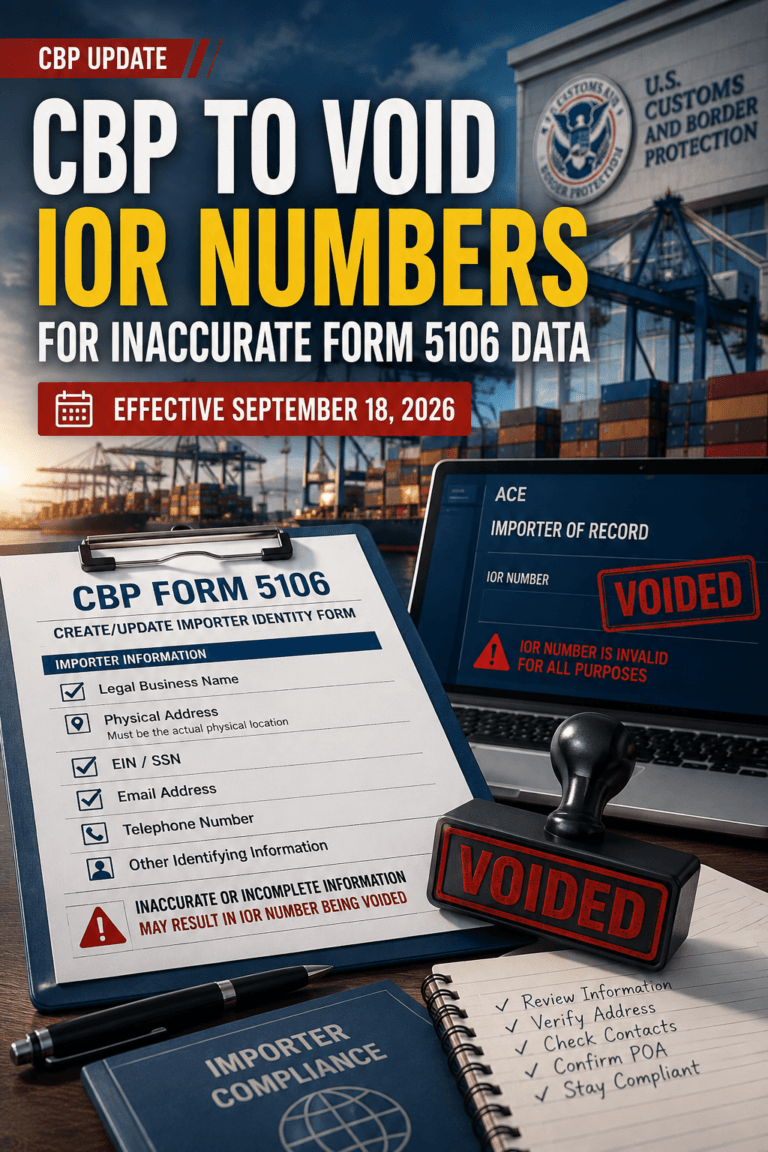
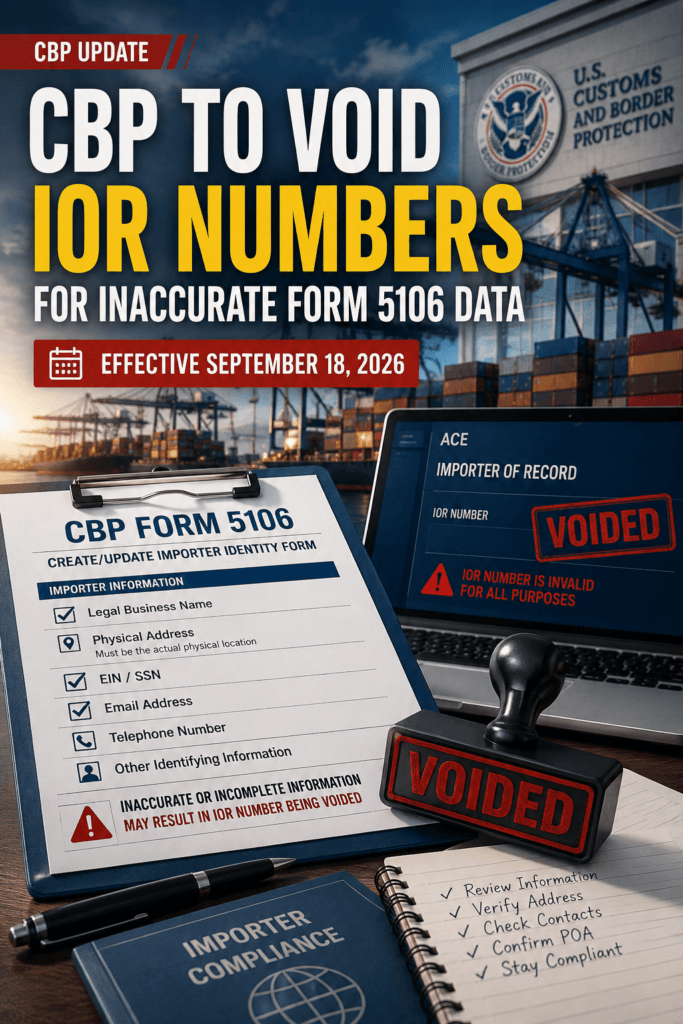
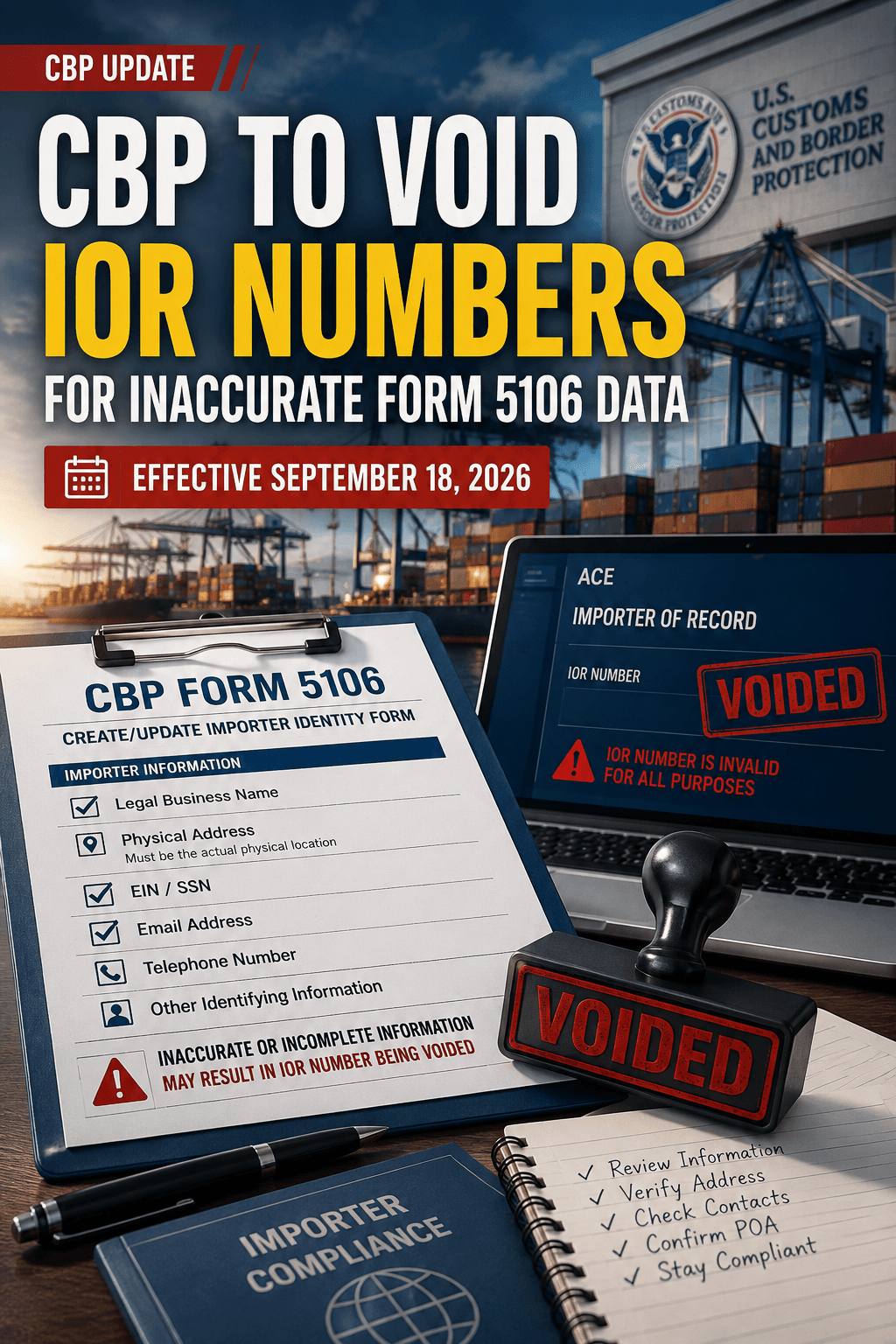
On August 19, 2026, U.S. Customs and Border Protection published a notice announcing enhanced enforcement of information submitted through CBP Form 5106, Create/Update Importer Identity Form. Starting September 18, 2026, CBP says it may immediately void an Importer of Record (IOR) number when the information on file is determined to be inaccurate or incomplete.
This is important because the IOR number is not just a registration number sitting in ACE. It is what identifies the party responsible for the import transaction and the duties owed to CBP.
If an IOR number is voided, CBP says the number becomes invalid for any purpose, including entering imported merchandise into the United States.
For companies that import regularly, this could become a very practical problem—not just a paperwork issue.
What Is Changing on September 18?
CBP is already reviewing Form 5106 information for new and existing importers.
The agency specifically says that importers, as well as customs brokers submitting information on an importer’s behalf, must make sure the information provided is accurate, complete, and belongs directly to the importer.
Beginning September 18, CBP will have the ability to void the IOR number when it determines that the information provided is inaccurate or incomplete.
The notice specifically identifies several areas that deserve attention:
- Physical business address
- Email address
- Telephone number
- EIN, SSN, or other importer identification number
- Importer legal name and other identifying information
The physical address requirement is particularly important.
CBP states that the physical address must be the actual physical location of the business or individual. It cannot be a customs broker’s address, freight forwarder’s address, registered agent, P.O. Box, business service center, or another person’s or entity’s address.
The same principle applies to contact information.
A broker’s email address or telephone number should not be entered on the Form 5106 in place of the importer’s own contact information.
Why Customs Brokers Need to Pay Attention
This change is not directed only at importers.
CBP specifically addresses customs brokers in the notice and says brokers have a duty to exercise due diligence when submitting importer information.
The agency states that brokers should not transmit information they know, or should know, is false or misleading, including information that has not been properly verified.
That creates an important operational issue for brokerage firms.
In many cases, a broker is the party actually preparing or transmitting the Form 5106 information through ABI on behalf of the customer. CBP is making it clear that the broker cannot simply rely on information that has been provided by a customer or another third party without appropriate verification.
There is also a separate POA requirement.
CBP says a customs broker submitting a Form 5106 on behalf of an importer must have a valid Power of Attorney executed directly with that importer. The POA cannot simply be obtained through a freight forwarder or another third party.
That is something brokerage operations should review now, particularly for older customers whose records may have been established years ago.
The Physical Address Requirement Could Create Problems
The physical address provision deserves special attention because this is an area where importer records can easily become outdated.
For example, an importer may have:
- moved to a new office
- changed warehouse locations
- changed corporate structure
- closed an old location
- started using a virtual office
- changed its registered agent
- moved operations outside the address originally provided to CBP
The fact that an address is associated with the company somewhere else does not necessarily make it acceptable as the Form 5106 physical address.
CBP specifically says the physical address must represent the actual physical location of the business or individual. The notice also clarifies that, for a business, the principal’s home address can qualify as the physical address.
This is an area where importers should review what is actually in their CBP record rather than assuming the information is correct.
What Happens If CBP Voids an IOR Number?
CBP says it will send written notice to the email address most recently submitted by the importer.
The notice will explain the reason for the action and provide information about requesting reestablishment of the IOR number.
A customs broker may also be copied if the broker filed the importer’s most recent entry.
CBP has established an email address for questions and requests involving a voided IOR:
The subject line specified by CBP is:
“Enforcing IOR Accuracy”
The importer or a customs broker with a valid POA can contact CBP regarding the voided number.
The important point for importers is that a voided IOR number can affect the company’s ability to make new entries. CBP explicitly states that a voided number cannot be used to enter imported merchandise into the United States.
That means an inaccurate Form 5106 could eventually turn into an operational problem at the time a shipment needs to clear customs.
What Importers Should Do Before September 18
Importers should not wait until an entry gets held to discover that their Form 5106 information is outdated.
A basic review should include:
1. Verify the legal company name
Make sure the name being used with CBP matches the actual legal entity.
This is especially important for companies that have gone through mergers, acquisitions, name changes, or ownership changes.
2. Verify the EIN
The EIN on file should belong directly to the importer.
If the company has multiple entities or related companies, make sure the EIN is associated with the correct legal entity making the entry.
3. Verify the physical address
Check the address currently maintained with CBP.
Do not assume that a registered agent, broker, forwarder, virtual office, or P.O. Box can be used simply because mail can be received there.
4. Verify the email address
The email address should belong to the importer.
This is particularly important because CBP says it will send notices concerning a voided IOR number to the most recently submitted email address.
If an old employee’s email address is still on the Form 5106, the company could potentially miss an important CBP notice.
5. Verify the telephone number
The telephone number should also belong to the importer rather than the customs broker or another third party.
6. Review the POA
Brokers should confirm that they have a valid POA directly with the IOR.
This is particularly important for foreign-owned companies and customers whose corporate structures have changed since the original POA was executed.
Foreign-Owned Importers Should Review Their Records Carefully
Foreign companies importing into the United States should pay particular attention to this change.
A foreign parent company, U.S. subsidiary, distributor, or related company may have several different entities involved in the supply chain. That can create confusion about which legal entity is actually the Importer of Record.
The Form 5106 needs to accurately identify the entity that is registered with CBP.
This is also why brokers should be careful when a customer says something like, “Use our parent company’s address,” or “Use our broker’s email because we don’t have a U.S. office.”
Those situations should be reviewed rather than automatically entered into the 5106.
CBP’s new notice makes clear that the information needs to identify the actual IOR.
This Is Bigger Than Just Form 5106
The new Form 5106 enforcement is part of a broader CBP effort to strengthen importer accountability.
The August 19 notice was issued as part of the implementation of Executive Order 14411, Strengthening Customs Enforcement, signed on June 3, 2026. The executive order specifically directs the government to strengthen customs enforcement and ensure that importers of record are correctly identified and accountable for duties and other legal obligations.
CBP also states that it is working on additional changes to importer eligibility regulations, guidance, and policies.
That means the September 18 enforcement date should probably not be viewed as a one-time Form 5106 cleanup.
It appears to be part of a broader effort to improve the quality of importer information maintained in CBP systems.
What Customs Brokers Should Do Now
For brokerage companies, this is a good time to review the customer onboarding and maintenance process.
At a minimum, brokers should consider reviewing:
- Form 5106 information
- EIN verification
- Legal entity information
- Physical address
- Importer’s email
- Importer’s telephone number
- POA documentation
- Corporate authority
- Ownership information where applicable
- Existing customers with older IOR records
New customers should also be handled differently going forward.
Instead of treating the 5106 as a routine form that simply needs to be completed, brokerage teams should treat it as part of the customer’s CBP identity verification process.
That distinction is becoming more important as CBP increases its focus on importer accountability.
What Happens Next?
The immediate deadline is September 18, 2026.
Until then, importers and brokers have an opportunity to identify and correct inaccurate information before CBP begins the new enforcement action.
CBP has not said that every IOR will be manually revalidated on September 18. The notice says the agency is implementing enhanced enforcement and will void an IOR number when it determines that the information provided is inaccurate or incomplete.
For that reason, importers should not wait for CBP to contact them.
A Form 5106 review now is much easier than discovering an IOR problem when a shipment is sitting at the port and the company needs to make entry.
The bigger message from CBP is straightforward: the information behind an IOR number needs to be accurate, current, and tied to the actual importer.
For importers and customs brokers, September 18 should be treated as a deadline to have those records in order.
To see customs related suject, visit our home page
Official References
- U.S. Federal Register — Accuracy of Importer of Record Data Submitted to CBP
View the Federal Register Notice - The White House — Executive Order 14411, Strengthening Customs Enforcement
View Executive Order 14411