
Corrugated Pizza Boxes Antidumping Duties: What Importers Need to Know
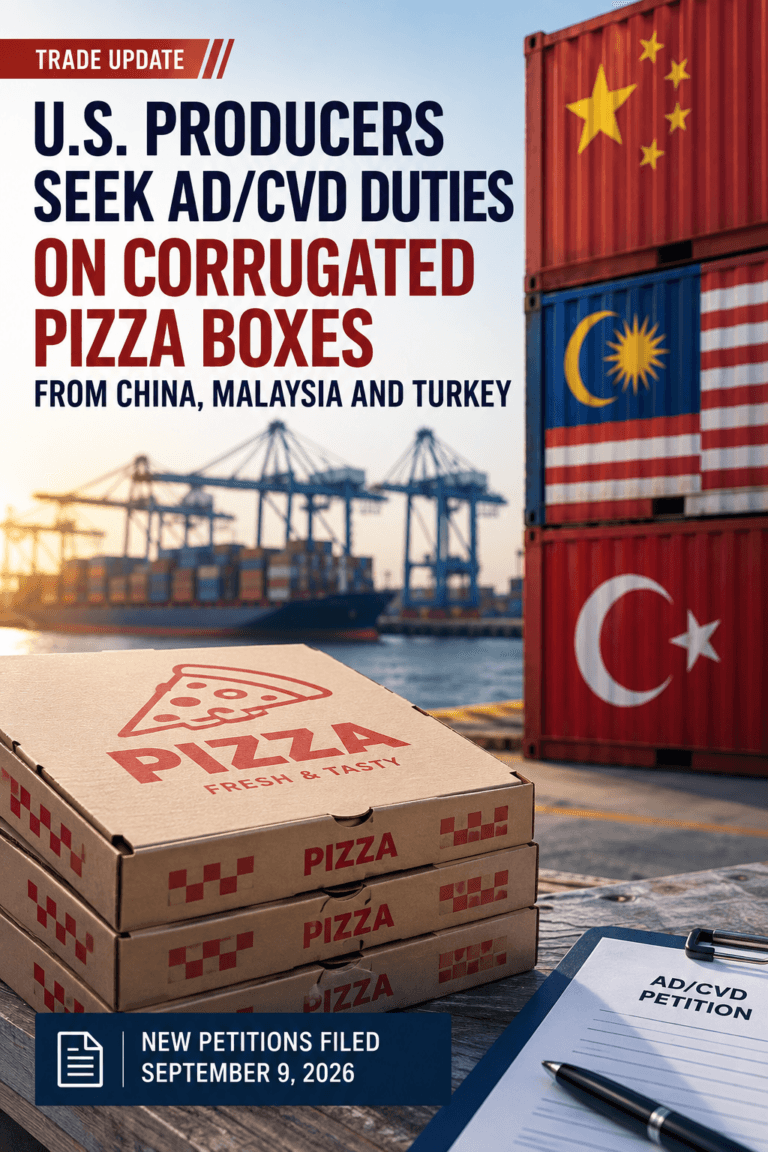
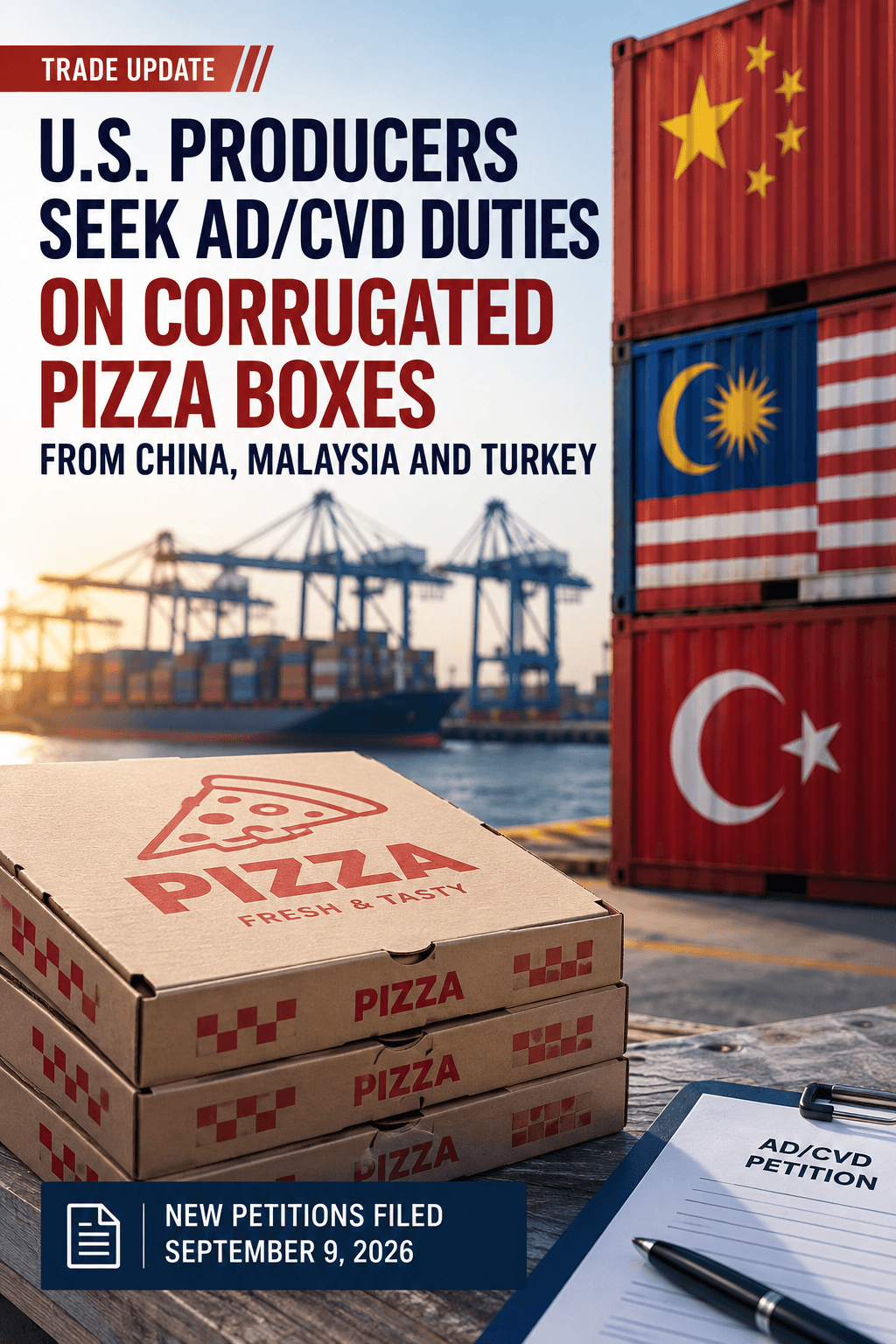
Corrugated pizza boxes antidumping duties are now being sought on imports from China, Malaysia and Turkey, potentially creating a new trade compliance issue for U.S. importers sourcing these products from the three countries. New petitions filed with the U.S. government request antidumping investigations covering imports from China, Malaysia and Turkey, along with a countervailing duty investigation covering imports from Turkey.
The petitions were filed on September 9, 2026, by Smurfit Westrock plc, Pratt Industries, Inc., and the United Steel, Paper and Forestry, Rubber, Manufacturing, Energy, Allied Industrial and Service Workers International Union. The filings request antidumping (AD) investigations for China, Malaysia, and Turkey, as well as a countervailing duty (CVD) investigation for Turkey.
For importers, this is still the beginning of the process. There are no final AD/CVD duties in place as a result of these petitions.
That could change later if the Commerce Department and U.S. International Trade Commission make the required affirmative determinations. For companies importing products that could fall within the proposed scope, the potential corrugated pizza boxes antidumping duties are worth monitoring closely.
What Products Are Covered?
The proposed investigations cover certain corrugated food service boxes, commonly known as pizza boxes.
The scope is broader than just a traditional assembled pizza box. According to the petition, the merchandise can include corrugated cardboard die-cut blanks that are imported flat and later folded or assembled in the United States. The proposed scope also covers certain boxes regardless of printing, color, coatings, liners, ventilation holes or other features.
The petition identifies HTSUS subheading 4819.10.0020 as a classification where the merchandise is typically entered. However, as with other AD/CVD cases, the written scope—not simply the HTS classification—controls whether merchandise is covered.
That distinction will matter for importers who believe their products are outside the case based only on the tariff number.
Alleged Dumping Margins Are High
The petitioners allege substantial dumping margins for the three countries:
| Country | Type of Petition | Alleged Dumping Margin |
|---|---|---|
| China | AD | 96.62% – 568.50% |
| Malaysia | AD | 110.73% |
| Turkey | AD | 120.65% – 210.37% |
| Turkey | CVD | Subsidies alleged; rate not quantified |
These are allegations made by the petitioners, not rates that CBP is currently collecting.
That distinction is important for importers. Seeing a 500%+ alleged dumping margin does not mean an importer will immediately pay a 500% additional duty.
Commerce must first conduct its investigation, determine whether dumping and/or countervailable subsidies exist, and establish the applicable rates. The USITC also has to determine whether the U.S. industry is materially injured or threatened with material injury.
When Could Importers See an Impact?
The first major date to watch is September 30, 2026, when an ITC staff conference is currently projected to take place.
The projected schedule calls for the ITC’s preliminary injury determination by October 26, 2026. Commerce is expected to initiate the investigations around September 29.
There is also an important distinction between the AD and CVD proceedings.
Based on the petition schedule, the earliest theoretical date for retroactive suspension of liquidation for the AD investigation is November 18, 2026, while the earliest theoretical CVD date identified probably is September 29, 2026. These dates are part of the projected investigation schedule and should not be treated as guaranteed collection dates.
Importers should therefore watch the case closely rather than waiting for a final order.
What Importers Should Do Now
If you are importing corrugated pizza boxes from China, Malaysia or Turkey, this is a good time to determine whether your merchandise falls within the proposed scope.
Importers should review:
- Country of origin
- Product specifications
- Whether boxes are imported assembled or as flat die-cut blanks
- HTS classification
- Manufacturing location of the corrugated cardboard
- Supplier and producer information
- Existing purchase orders and contracts
- Entries that could remain unliquidated during the investigation
The country of origin issue is particularly important. The proposed scope states that the country of origin of a subject corrugated pizza box is determined by where the corrugated cardboard sheet is produced.
That means simply performing additional processing in another country may not necessarily take the merchandise outside the investigation.
What Happens Next?
The petitions will now move through the normal AD/CVD investigation process.
Commerce is expected to formally initiate the investigations, while the USITC will consider whether there is a reasonable indication that the U.S. industry is being materially injured or threatened by the subject imports.
If the investigations continue, Commerce will eventually issue preliminary and final determinations on dumping and subsidies. The USITC will also make its injury determinations before any final AD/CVD orders can be issued.
For importers, the main takeaway is simple: this is not a new duty yet, but it could become one.
Companies that regularly import pizza boxes from the three named countries should identify potentially affected merchandise now and keep an eye on the investigation schedule. Once suspension of liquidation and cash-deposit requirements become effective, waiting until the shipment arrives at the port will be too late to address the underlying exposure.