
The product exemptions underpinning President Trump’s new Section 122 surcharge are, in practical terms, almost identical to those under the IEEPA regime it replaces.
While the legal authority changed following the Supreme Court decision, the commercial landscape of what enters the United States exempt from the 10 percent surcharge remains largely intact. The Section 122 Annex II carries forward the consolidated IEEPA exclusion list with minimal structural adjustments: eleven drone codes were added, nineteen semiconductor-related codes were reclassified from the aircraft-scoped list to the general list, and sixteen printed-matter codes were removed.
The net effect is administrative refinement rather than substantive policy change.
Eleven Exemption Channels Defined in Annex I
The Section 122 proclamation defines the 10 percent surcharge and its exemptions through eleven HTS Chapter 99 provisions in Annex I (9903.03.01 through 9903.03.11).
The first entry establishes the 10 percent surcharge itself. The remaining ten entries carve out defined exceptions:
- 9903.03.02 – Goods in transit: Articles already en route before the proclamation date.
- 9903.03.03 – Annex II product list: 1,655 product codes exempt from the surcharge, some limited to civil aircraft use.
- 9903.03.04 – Religious and tropical items: Eleven entries including religious texts and certain tropical commodities.
- 9903.03.05 – Civil aircraft: Parts and components for civil aircraft.
- 9903.03.06 – Section 232 products: Goods already covered by Section 232 investigations, with the same content-share calculation methodology preserved.
- 9903.03.07 and 9903.03.08 – Canada and Mexico: USMCA-qualifying goods.
- 9903.03.09 – CAFTA-DR textiles: 1,610 apparel codes from six Central American and Caribbean member states.
- 9903.03.10 – Donations: Articles imported for disaster relief and charitable purposes.
- 9903.03.11 – Informational materials: Printed matter, films, recordings, and artworks.
Each channel has a direct IEEPA precedent. The Section 232, USMCA, donation, and informational materials exemptions carried over without meaningful alteration.
The primary areas of technical change are found in Annex II and in the formal codification of CAFTA-DR textiles. You can find the list here
The Baseline Structure: From IEEPA to Section 122
How Section 122 Exemptions Compare to IEEPA
Under the IEEPA reciprocal tariffs established by Executive Order 14257 on April 2, 2025, products listed in Annex II were excluded from the surcharge. That annex was amended five times over ten months. By February 19, 2026, it contained 1,692 codes, distinguished by scope markers separating general exemptions from those limited to civil aircraft use.
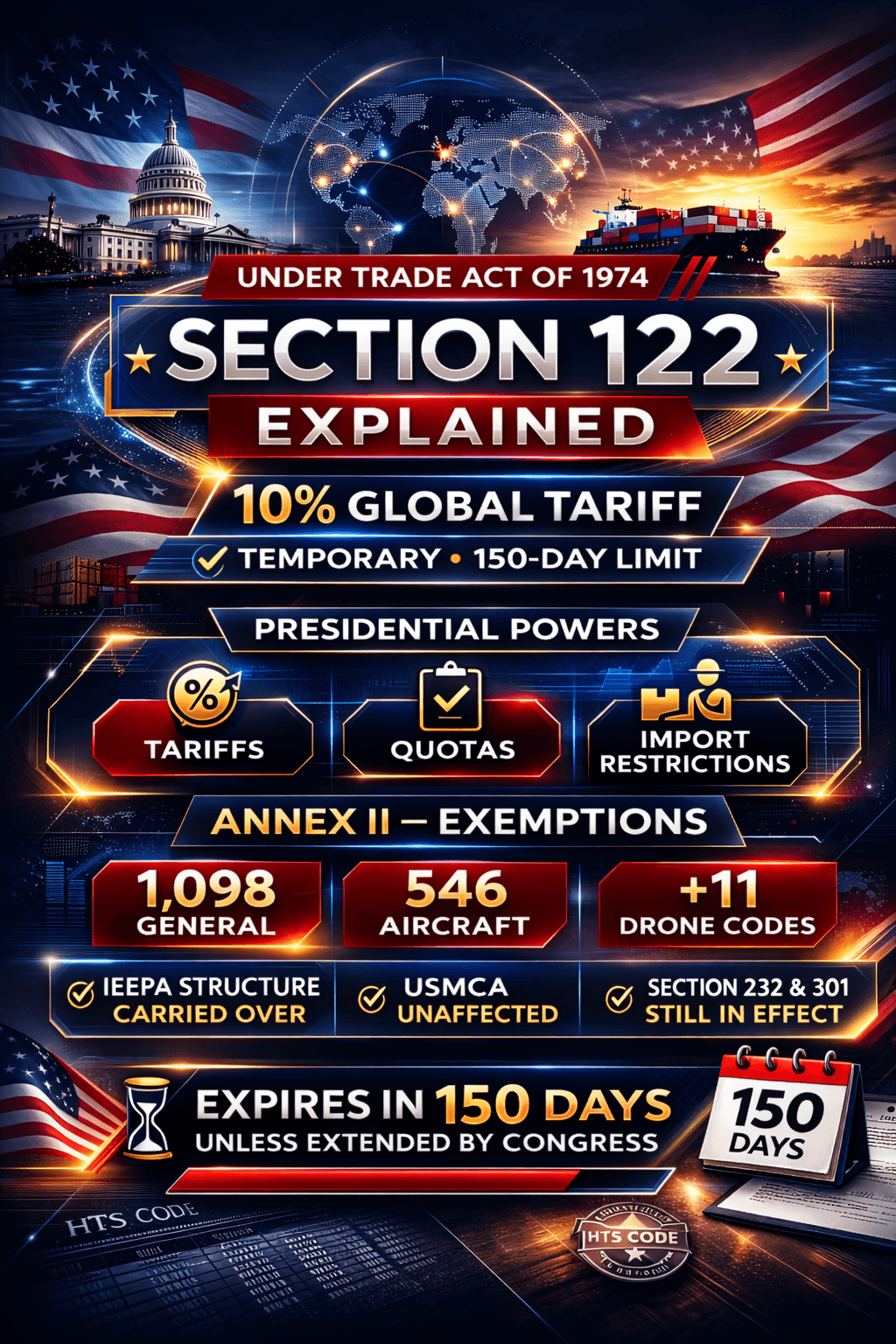
Section 122 preserves this framework. The February 20, 2026 proclamation defines exemptions through a single Annex II containing 1,655 entries.
Each entry includes a “Scope Limitations” column:
- 1,098 entries carry no limitation and are fully exempt.
- 546 entries are marked “Aircraft,” exempt only when entered as civil aircraft parts or components.
- 11 entries are marked “Ex,” limited by product description.
The surcharge was formally raised to 10 percent on February 22.
Changes to the General Product List
The general section of Annex II now contains 1,098 unrestricted codes. Under IEEPA, the equivalent section contained 1,084.
The net increase of 14 reflects two offsetting adjustments.
First, all 57 semiconductor-related codes previously separated by Presidential Memorandum were incorporated directly into the general list. Of those 57, forty-one were newly added to the unrestricted section; sixteen already appeared there.
Second, sixteen printed-matter codes were removed entirely from Annex II. These included exercise books, newspapers, coloring books, music scores, and maps from Chapters 48 and 49.
However, these products remain exempt under the informational materials provision (9903.03.11), which replaces IEEPA’s enumerated statutory list with a broader descriptive exemption covering printed matter, films, recordings, and artworks.
This is a structural simplification, not a tightening of scope.
Changes to the Aircraft-Scoped List
Under IEEPA, 554 codes were exempt only when entered as civil aircraft parts or components. Under Section 122, the aircraft-scoped list contains 546 entries.
Two offsetting adjustments explain the difference.
Nineteen codes moved from the aircraft-only list into the general exemption category. Eighteen of these were already semiconductor-related IT products such as computers, smartphones, networking equipment, storage devices, and monitors. These products accounted for approximately $192 billion in U.S. imports in 2024 and were already broadly exempt under IEEPA.
Only one code — titanium waste and scrap — was genuinely aircraft-specific.
This reclassification represents administrative consolidation rather than commercial expansion.
The only genuinely new exemptions under Section 122 are eleven unmanned aircraft codes under HS heading 8806. One covers passenger-carrying drones. The remaining ten cover non-passenger drones, differentiated by flight mode (remote-controlled versus autonomous) and maximum takeoff weight, ranging from under 250 grams to over 150 kilograms.
These codes did not exist under IEEPA and represent the sole substantive addition to the exemption universe.
CAFTA-DR Textiles Formalised
The CAFTA-DR textile exemption (9903.03.09) now formally covers 1,610 apparel codes when imported from Costa Rica, the Dominican Republic, El Salvador, Guatemala, Honduras, and Nicaragua.
Under IEEPA, preferences for certain members existed through bilateral arrangements but lacked consolidated codification.
Section 122 formalises this treatment as a single, code-enumerated provision derived from WTO textiles agreements and mapped into current HTS classifications.
Commercial Reality: Unchanged
USMCA preferences remain intact. Section 232 products — including steel, aluminium, copper, lumber, and automobiles — remain excluded from the surcharge. Partial derivative rules continue to apply where relevant.
Religious and tropical provisions remain unchanged. Donation and informational materials exemptions are carried forward.
The commercial reality is clear: while the legal authority shifted from IEEPA to Section 122, the practical universe of exempt imports did not materially change.
The Section 122 regime is, in substance, a structural continuation of the IEEPA framework — with modest code adjustments and a narrowly defined expansion for unmanned aircraft.
For importers, the compliance architecture remains familiar. The statute changed. The product map largely did not.
Related: