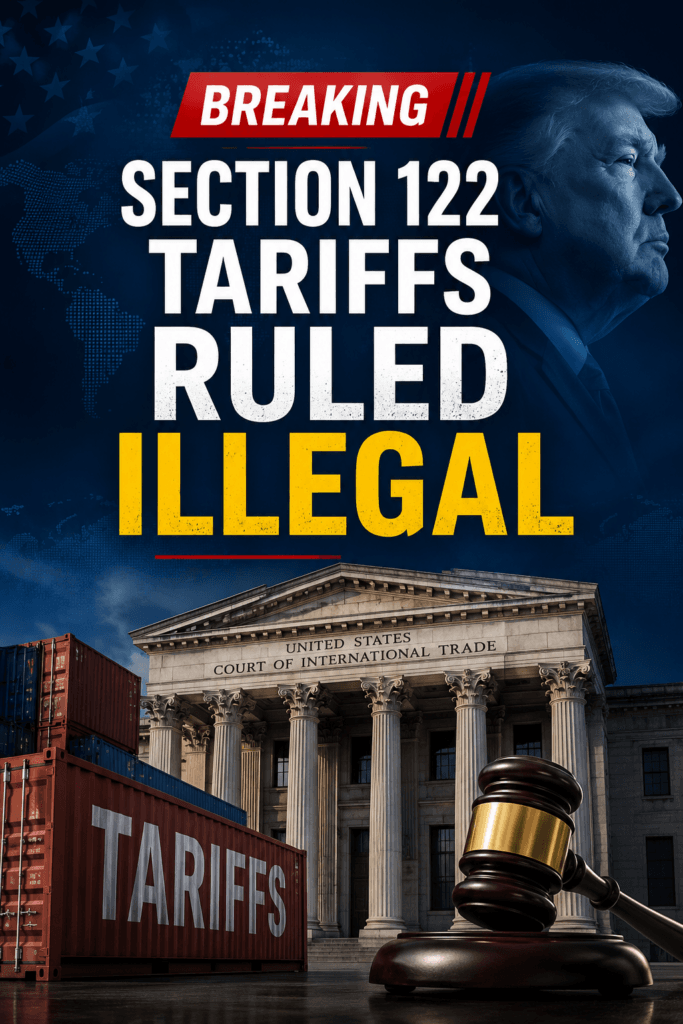


The Section 122 global tariff is now the administration’s next move after the Supreme Court ruled that the President cannot rely on IEEPA to impose broad import tariffs.
President Trump confirmed this afternoon that a 10% global tariff will be implemented under Section 122 of the Trade Act. The announcement came shortly after the decision from the Supreme Court of the United States was released and during remarks at the White House.
The legal authority has changed. The policy direction has not.
Why the Supreme Court Blocked IEEPA Tariffs
The Supreme Court determined that IEEPA does not provide authority for general tariff measures. IEEPA has historically been used for sanctions and emergency economic restrictions, not for across-the-board import duties.
That ruling effectively removes the IEEPA tariff structure. In response, the administration pivoted to Section 122.
This is not a rollback of tariffs. It is a shift in the statutory basis.
What Happens to Reciprocal Tariffs
The administration also indicated that the new 10% Section 122 global tariff would replace the higher reciprocal tariff framework that had been discussed previously.
In practical terms, this means the broader reciprocal tariff structure is being cancelled and consolidated into a flat 10% global rate.
For importers, this is not necessarily relief. While higher country-specific reciprocal rates may no longer apply, the 10% tariff would now extend across virtually all trading partners.
The structure changes. The exposure remains.
Read our analysis of the Supreme Court IEEPA ruling.
What Is the Section 122 Global Tariff
Section 122 allows the President to impose temporary tariffs when there is a serious economic disruption or imbalance.
Under the announced plan:
• A 10% global tariff would apply broadly to imported goods
• The measure would operate separately from IEEPA
• Implementation details are still pending formal publication
If fully applied, the Section 122 global tariff could impact most import categories unless specific exclusions are introduced.
Section 232 and Section 301 Remain in Effect
President Trump also confirmed that:
Section 232 tariffs remain active.
Section 301 tariffs remain active.
For many importers, this means the Section 122 global tariff may stack on top of existing duties.
Companies already subject to 25% Section 301 exposure or Section 232 duties should model the cumulative impact immediately.
Operational Impact for Importers
If the Section 122 global tariff moves forward as announced, importers should review:
• Landed cost projections
• Open purchase orders
• DDP contracts
• Existing HTS classifications
• Potential new Chapter 99 tariff provisions
Waiting for Federal Register publication may leave companies reacting instead of preparing.
The compliance risk is not theoretical. Any broad global tariff affects pricing, supply chain planning, and contract structure.
What Happens Next
Key questions remain:
When will the Section 122 global tariff take effect
Will exclusions be available
How long will the measure remain in place
How CBP will operationalize the tariff lines
Until official publication, the scope and mechanics are still developing.
What is clear is this: the Court narrowed one legal tool. The administration immediately activated another. Importers should expect continued tariff pressure under a new statutory framework.