
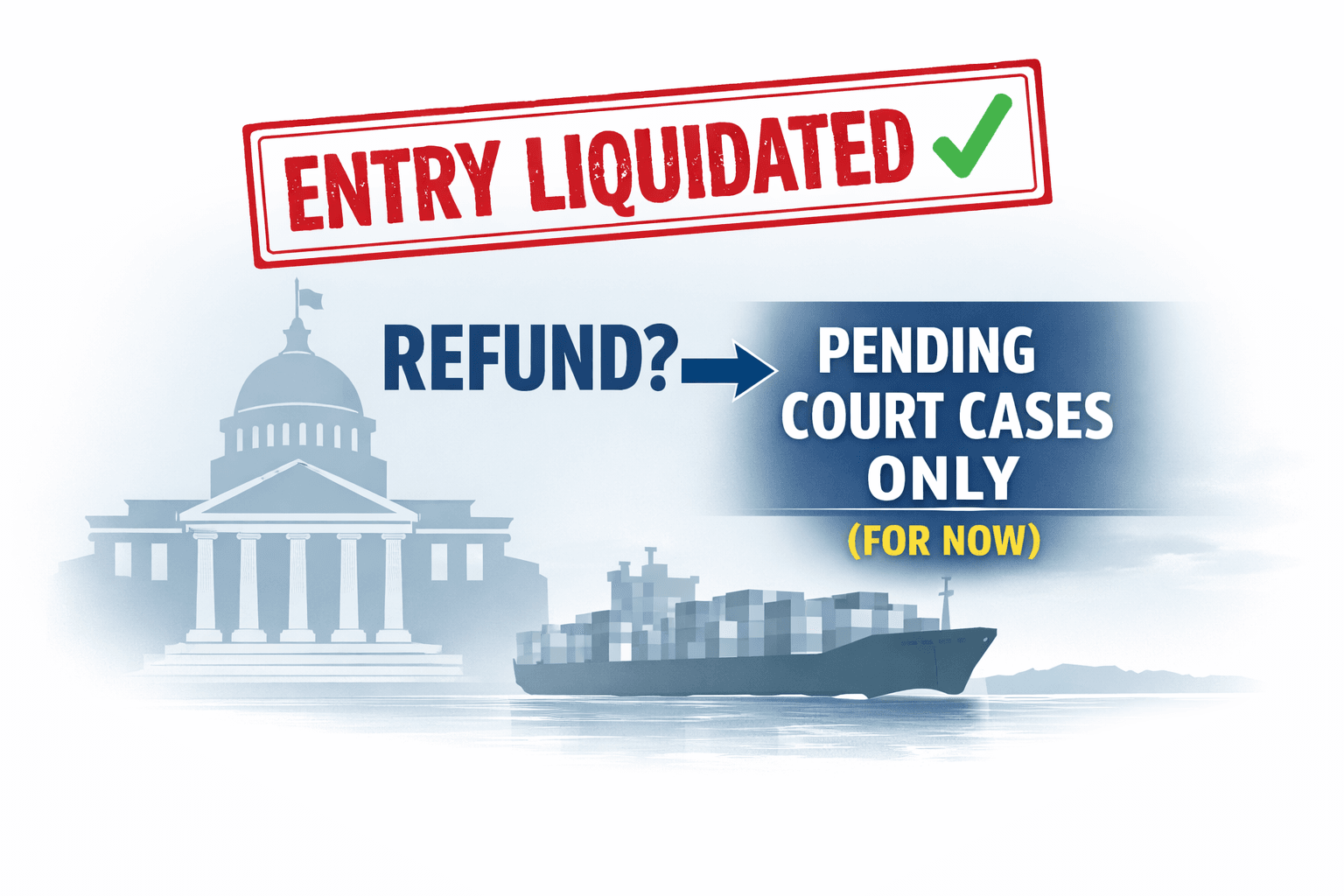
The U.S. Court of International Trade (CIT) just signaled that if you’re already in a pending IEEPA tariff court case, the government likely can’t later argue that liquidation prevents refunds—because of judicial estoppel. But the court also suggested that simple CBP protests after liquidation may not be enough to recover IEEPA tariffs. Court of International Trade
What happened
On December 15, 2025, the Court of International Trade issued Slip Op. 25-154 in AGS Company Automotive Solutions, et al. v. United States (Consol. Ct. No. 25-00255). Court of International Trade+1
The case is part of the broader fight over IEEPA-based tariffs, which are also at the U.S. Supreme Court in Trump v. V.O.S. Selections, Inc. (No. 25-250) (cert granted). Supreme Court+1
The key takeaway: the CIT refused to stop liquidation (no preliminary injunction), largely because the U.S. government has repeatedly told courts it won’t oppose reliquidation/refunds for plaintiffs if the IEEPA tariffs are ultimately held unlawful—so the court said plaintiffs did not show “irreparable harm.”
The big legal point: “Judicial estoppel” (why it matters)
The court explained that because the government has benefited from arguing “refunds will still be available after liquidation,” it would be judicially estopped (basically: legally blocked) from later switching positions and claiming liquidation prevents refunds in that pending case. Court of International Trade+1
Translation: for plaintiffs already in front of the CIT in these IEEPA refund challenges, liquidation may not be the door slamming shut—at least based on what the government has already represented to the courts.
Critical limitation (don’t miss this)
This is not a universal guarantee for every importer.
✅ What this decision helps (right now)
- Pending court cases (existing plaintiffs) seeking IEEPA tariff refunds where the government has taken (and benefited from) the “refunds remain available” position. Court of International Trade+1
❌ What it does not clearly solve
- Importers not already in a pending case.
- Importers relying only on post-liquidation administrative protests to recover IEEPA tariffs.
The opinion explicitly discusses the risk that IEEPA liquidations may involve “ministerial” CBP actions that may not be protestable, referencing Federal Circuit precedent (Rimco). Court of International Trade
What about protests (19 U.S.C. § 1514)?
The court noted the typical route—protest then sue after denial—may not be available if CBP is acting in a purely ministerial way when liquidating certain IEEPA duties. That means a protest alone may not preserve refund rights for everyone.
Practical takeaway: If your current “plan” is only “we’ll just protest after liquidation,” this decision is a warning sign that strategy may be risky for IEEPA tariffs.
What importers should do now (practical steps)
- Identify exposure
- Pull a report of entries where IEEPA duties were deposited (and which are approaching liquidation).
- Check your posture
- Are you already part of a pending CIT case on IEEPA tariffs? If yes, this ruling is generally supportive on the “liquidation won’t automatically kill refunds” argument.
- Don’t assume protests are a backstop
- Based on the court’s discussion, treat “we’ll protest later” as not guaranteed for IEEPA refund recovery.
- Talk to counsel about preservation options
- The refund pathway is still evolving and depends on future rulings (including the Supreme Court’s outcome in V.O.S.).
(◈) Broker reality check: the safest refund strategy is the one that preserves rights before the deadline hits—because once liquidation and deadlines pass, your options can narrow fast.
Why this matters for the market
Importers have been racing to “protect the refund” because liquidation timing was viewed as a major risk. This CIT decision reduces that risk for pending cases, but it does not eliminate uncertainty for everyone else.
Disclaimer
This article is for general informational purposes and is not legal advice. Refund rights and procedures may change depending on future court decisions.