What happened
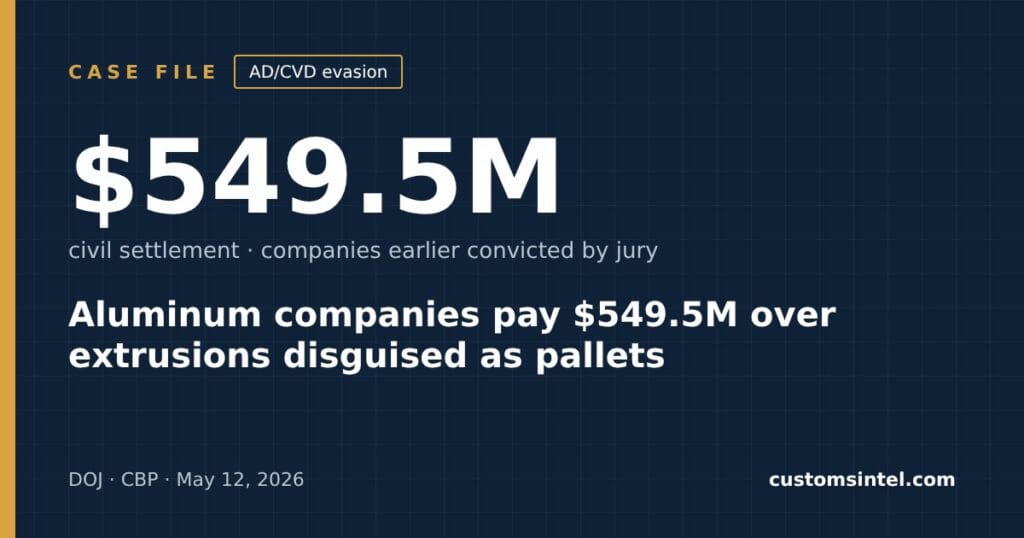
On May 12, 2026, the Justice Department announced that Perfectus Aluminum Inc., Perfectus Aluminum Acquisitions LLC and four related California warehousing companies agreed to pay $549.5 million. The money settles False Claims Act allegations about duties that were not paid on aluminum extrusions from China imported between July 2011 and June 2014.
How the scheme worked
During those years, aluminum extrusions from China were subject to antidumping and countervailing duties. According to the Justice Department, the defendants imported more than 2.2 million “pallets.” On their CBP Form 7501 entry summaries, they declared these as finished merchandise that was not subject to AD/CVD.
The government says the pallets were simply aluminum extrusions spot-welded together so they looked like working pallets. It also says there were no customers for these pallets. In plain terms, raw material was dressed up as a finished product to get it outside the duty orders.
How it was caught
Whistleblowers brought the case. Two individuals and the Aluminum Extruders Council, an industry group, filed qui tam suits under the False Claims Act in federal court in California. There was also a criminal case. In August 2021, a jury in the Central District of California convicted the Perfectus companies of conspiracy to defraud the United States, among other charges.
The outcome
The $549.5 million civil settlement resolves the False Claims Act claims. The whistleblowers will receive 17.5% of the settlement money returned to CBP. The settlement resolves allegations, and the Justice Department release does not say the companies admitted liability in the civil case.
What to check in your own business
If you claim that a product is outside an AD/CVD order because it is “finished,” be ready to prove it. Is it really a complete, usable product? Who buys it, and for what use? Would it hold up if CBP examined the goods? If your position depends on a description and not on the goods themselves, ask Commerce for a scope ruling before you import. This case also shows that an industry group, not only a former employee, can file a whistleblower suit.