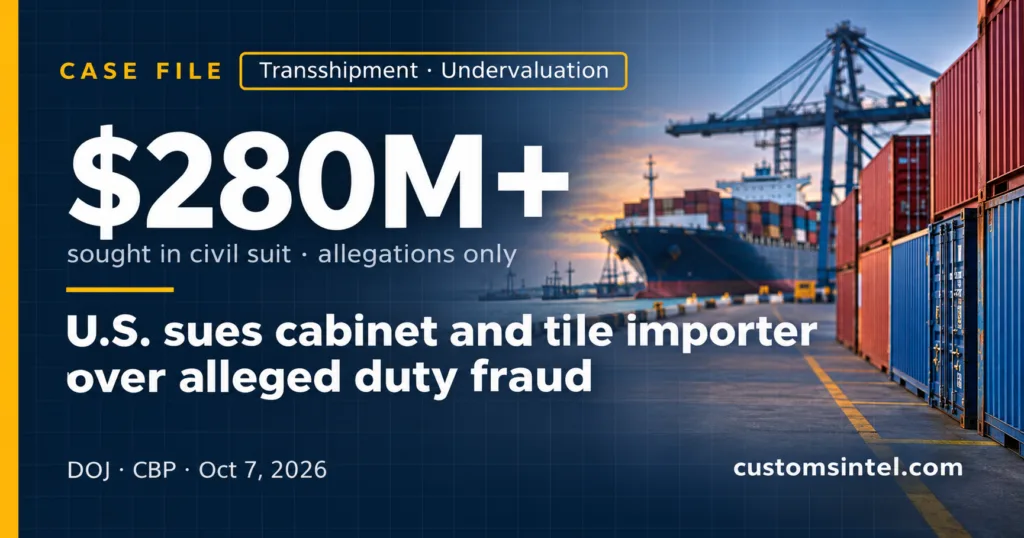
On October 7, 2026, the Justice Department announced that the United States had filed a civil lawsuit in the U.S. Court of International Trade against Uni-Tile & Marble Inc., an importer and retailer of kitchen and bath construction and remodeling products. The suit also names the company’s chief executive officer. The government is asking for more than $280 million: $67.9 million in unpaid customs duties and $222.5 million in fraud penalties.
The goods were wooden cabinets and vanities, quartz surface products, ceramic tiles and other merchandise imported from China. According to the Justice Department, from September 2018 to August 2023 the defendants fraudulently transshipped, undervalued and misdescribed this merchandise through a scheme that used multiple shell companies. The government says false statements and omissions were made to CBP on 503 entries. In plain terms, the government alleges that CBP was given the wrong origin, the wrong value and the wrong description of the goods, so less duty was paid than was owed.
The release does not say how the case was first detected, but it shows this was not a quick audit. In December 2025, federal prosecutors in the Northern District of California announced criminal charges against the company, its CEO and others, including conspiracy, wire fraud, smuggling and international money laundering. The new civil case is separate. It asks the court to enforce CBP’s demand for duties and penalties under 19 U.S.C. § 1592(a) of the Tariff Act of 1930. Both cases are allegations only. No court has made a determination of liability, and the criminal charges are unproven.
The outcome is still open, but the numbers are worth a close look. The penalty claim alone is more than three times the duty the government says is unpaid. When CBP and the Justice Department allege fraud, an underpayment can turn into a debt many times larger.
For importers, the lesson is practical. Know who your real supplier is and where the goods are actually made, especially when invoices come from a trading company or a new seller in a third country. Check that the value on your entry matches what you really pay, including any payments made outside the commercial invoice. Make sure the entry description matches the product you sell. If something looks wrong, talk to your broker or trade counsel early, before CBP raises it first.