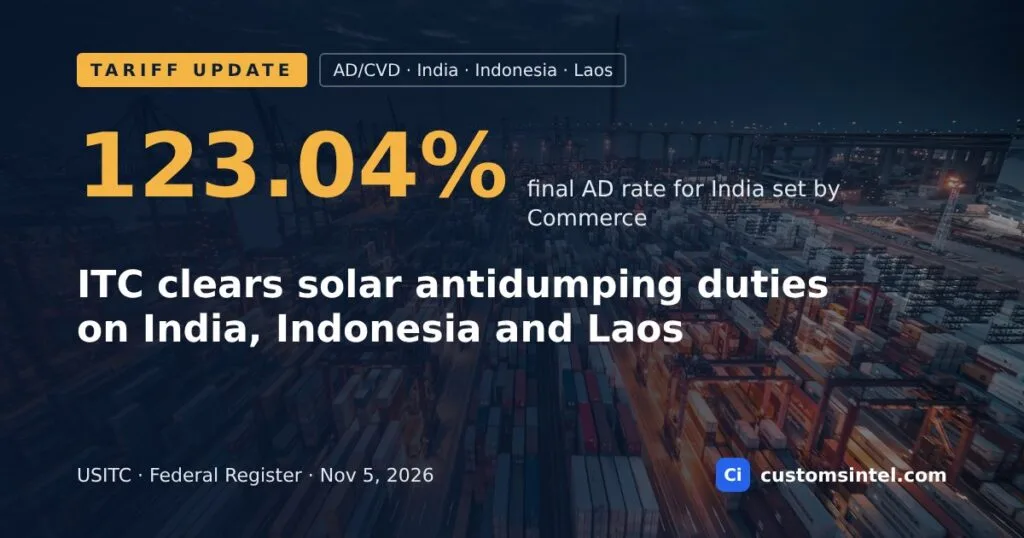
Solar antidumping duties on crystalline silicon solar cells and modules from India, Indonesia and Laos cleared their last big hurdle when the U.S. International Trade Commission published its final injury determinations in the Federal Register on November 5, 2026. Commerce should issue the antidumping and countervailing duty orders soon, so importers from these three countries should check their open entries now.
What the ITC solar antidumping duties notice says
The ITC found that the U.S. solar industry is materially injured by imports of crystalline silicon photovoltaic cells, whether or not assembled into modules, from India, Indonesia and Laos. The vote was affirmative in all six cases, three antidumping and three countervailing duty investigations (Nos. 701-TA-772-774 and 731-TA-1756-1758). The Commission filed its determinations on November 2. The petitions came from the Alliance for American Solar Manufacturing and Trade.
The notice also deals with critical circumstances. For Indonesia, the ITC found that the surge of imports covered by Commerce's critical circumstances findings is likely to seriously undermine the orders. For India and Laos, it found the opposite. That one footnote decides whether duties reach back to entries made before the preliminary determinations.
Who is affected by the new solar antidumping duties
The scope covers cells and modules classified under HTS subheadings 8541.42.00 and 8541.43.00. As in every AD/CVD case, the written scope controls, not the HTS number. Anyone buying panels made with cells from these countries, or modules assembled there, needs to look closely at country of origin. Developers and installers with landed-cost contracts should also review their exposure.
The solar antidumping duties are high. Commerce's final determinations, published September 16, 2026, set an antidumping rate of 123.04% for India, with a cash deposit of 107.17% after subsidy offsets, and a countervailing rate of 126.09%. For Indonesia, the antidumping rate is 94.36% and the all-others subsidy rate is 73.20%. For Laos, the antidumping margin is 65.43%, with a 65.03% cash deposit, and the all-others subsidy rate is 82.03%. Several company rates are higher, and most were based on adverse facts available. AD and CVD deposits apply on top of each other, along with any other duties that already cover the goods.
When the solar antidumping duties start
The ITC vote is not the order itself. Commerce will now publish the formal orders, and those notices will give the exact cash deposit instructions for CBP. The publication date for the orders needs checking, but it normally follows the ITC notice closely.
For solar antidumping duties, Indonesia is where the timing matters most. Commerce found critical circumstances for Indonesian imports, and the ITC agreed they would undermine the orders. Under the countervailing duty determination, suspension of liquidation for PT Blue Sky Solar Indonesia and all other non-examined companies reaches back to entries on or after November 28, 2025. For PT REC Solar Energy Indonesia, it starts February 26, 2026. On the antidumping side, the retroactive period starts 90 days before the April 28, 2026 preliminary determination, which works out to about January 28, 2026. Confirm that date against the order when it is published.
For India and Laos, the ITC's negative critical circumstances finding means duties should not reach back before the preliminary determinations. How CBP will treat deposits already made for that earlier period needs checking in the orders and the CBP messages that follow.
What solar importers should do now
Before the orders appear, pull every entry of cells and modules from India, Indonesia and Laos made since late 2025 and match each one to the producer and exporter named on the invoice. The company rate depends on that pair, so an exporter that is not a named respondent may still get the producer's rate. Make sure your broker is using the correct case numbers and that cash deposits were posted on the right entries.
If you import Indonesian goods, plan cash flow for the retroactive deposits. If you have a bond, check whether it is still large enough with these rates. And if your supplier is moving production to a new country, keep records of where the cells were made, because origin of the cell is usually what decides solar cases.
The bigger picture on solar trade cases
This is the latest round in a long series of solar AD/CVD cases. Each time orders take effect, supply tends to shift to the next country, and a new petition often follows. Importers who track origin of the cell, not just the module, will be in a better position when that happens. Final solar antidumping duties are only settled later, in administrative reviews that usually start about a year after the orders.
For more on how preliminary cash deposits work in a live case, see our recent post on OCTG antidumping duties for Austria, Taiwan and the UAE. We will add the solar orders to our tariff change log once Commerce publishes them.